

Designing an AI agent finance teams would trust inside their own model
The SmartModel Agent is Drivepoint's AI agent inside Excel. Finance teams at consumer brands open the model they already use, click chat, and ask it to pull in data, roll the model forward, or answer a question grounded in their own cells.
I designed the agent's foundation: the interaction model, its first skill (data import), and the trust behavior the whole thing runs on. I was the lead and only designer on it, covering UX, UI, interaction, agent behavior, and copy.
AI already worked in the spreadsheet. It just didn't work for the team
Finance operators at consumer brands were already using Claude and ChatGPT to clean exports and build quick models. It worked in single-player mode only. The model file was too big to keep pasting in, so data went stale, a good prompt couldn't be reproduced a week later, and one person ended up being the only one who could run any of it. The work never compounded.
Drivepoint's own import flow had the same shape of problem: a source-first wizard with cryptic table names, no scheduling, no error context. My job was to design an agent dependable enough for a whole finance team to rely on every month, inside the model they already use.

AI automapping
The brief was "better imports." The research said "build the front door"
The project started as Data Import V2, a chat interface bolted onto the existing flow. Two things redirected it. A generative interview with an operator at one of Drivepoint's portfolio brands showed how finance people already use AI in a spreadsheet: reconciliation, fuzzy mapping, SKU classification, scenario modeling across workbooks. The appetite was broad. And five rounds of testing with six participants kept returning the same verdict: scoping chat to imports alone was too narrow, since imports were already simple and the agent earned its place on the messier work.
So I reframed it. Instead of a chat attached to imports, the chat became the homepage of the Add-In, with data import as its first skill. That is the decision the rest of the product rests on. The front door was built to hold capabilities it did not have yet, which is why the agent could grow past imports without a redesign. The version that shipped does three things from the first prompt, importing data, rolling the model forward, and answering questions grounded in the cells, all on the surface I designed for the first one.
How I built it
An agent is a conversation, and a conversation does not read on a static screen. Whether a proposal lands cleanly, how it feels to tweak a request and send it again: that only shows up when the thing runs. So I built the agent as working software from the start.
I prototyped in real, interactive code, using AI to write it while I directed the structure and the agent's behavior. (I move between Claude, v0, and Figma Make depending on what a feature needs.) Stakeholders never reviewed a picture of the agent. They talked to a working one in the same session their feedback came up, and we pressure-tested it against real customer scenarios on the spot.
That changed the designs, not just the speed. A direction could go from idea to clickable in one conversation, so the reframe from import tool to agent and the calls that followed were tested against how the agent actually behaved, before anyone wrote a line of production code. Figma came at the end, for full state coverage and the handoff to engineering.
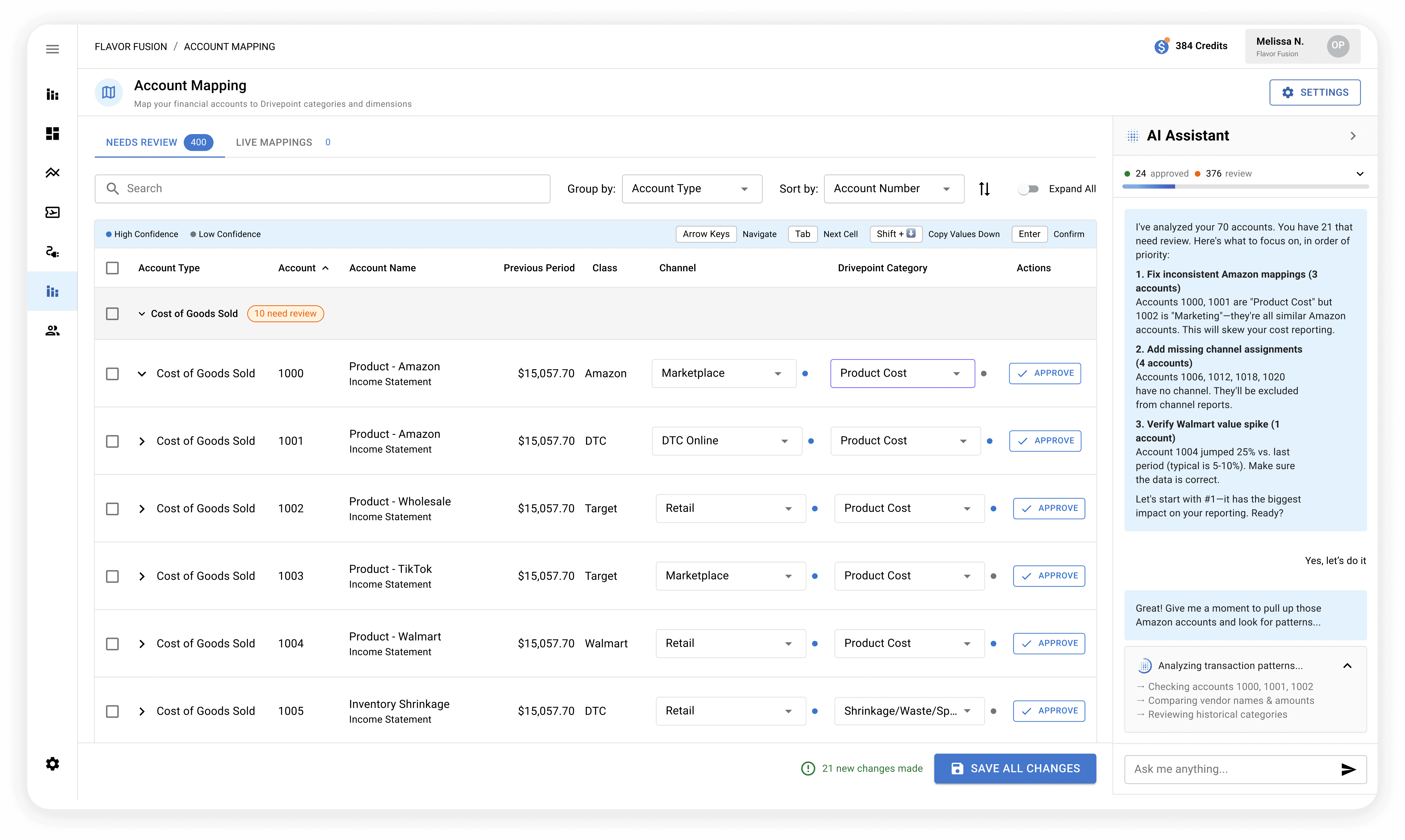
New workflow for mapping accounts
Three decisions that made the agent safe to act
The agent writes to a live financial model, where a wrong write can corrupt a forecast and go unnoticed for weeks. People only hand that over if the agent earns it.
Propose, then act. Nothing touches the model without an explicit yes. The agent proposes a specific action, "Ready to import 1,247 rows from Shopify to R - Shopify Monthly," with Allow and Deny inline, and the user can edit the proposal in place instead of denying and restarting. On the autonomy spectrum it sits at plan-and-propose, short of acting on its own, because a wrong write is expensive.
Show the work. The agent exposes a collapsible thinking state: what it read, what it matched, what it is about to do. A finance user can audit the reasoning before approving rather than trusting a black box.
Never a dead end. When an import fails or the agent hits a wall, it says what happened and offers a way through, like a fallback to the classic import screen. The agent never traps the person using it.
I also cut suggestion chips, after testing showed they made people treat the agent as a short menu of commands instead of something they could ask anything.
New workflow for mapping accounts
What shipped
The SmartModel Agent launched in May 2026 inside the Drivepoint Add-In. The chat I designed replaced the feature-list homepage and is now the agent's primary surface.
Data import as the first skill. It shipped as the first of eighteen pre-built CPG-finance skills. The architecture held: new skills landed on the same front door without a redesign.
Roll-forward in one step. Advancing the model into the new month used to be a confusing two-step job. The agent now handles it in one, pulling in the latest actuals the new month needs and reminding you when it's due.
Grounded in the real model. The agent reads the actual cells and shows its work, so "what was DTC gross sales last month" is answered from the model itself.
Single-player became multiplayer. Anyone on the team can ask the model a question. The analyst who used to know how to run everything stops being the help desk.

Manual bulk approval
What I'd do differently
Design the editing and maintenance state earlier. Most of the effort went into the first run. Editing saved work turned out to be the harder problem, and duplicate-and-customize was a workaround more than an answer. I would treat it as a first-class surface from the start.
Pressure-test a front door built for skills that don't exist yet. The architectural bet was right, but it is hard to validate a container for capabilities you cannot put in front of users. With the skills now shipping, the honest next step is re-testing the front door against the real range of what people ask it.

© 2025 melissa neira